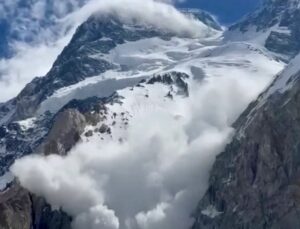
There was only one summit push on K2 this year, very late in the season and in uncertain conditions. The push came after half the climbers in Base Camp called off their attempts. Three small commercial teams reached the summit on August 11, and a single independent climber followed 24 hours later. The final part of the descent was a sort of russian roulette: of the 40 climbers, one lost her life, and several were injured by constant rockfall.
We have asked those who were on the mountain about the bittersweet season.
Rising temperatures and tension
The climbing season in the Karakoram was characterized by excessively high temperatures, which severely impacted conditions. The climbing was particularly poor to 6,000m, and negatively affected the climber’s acclimatization process, particularly those climbing without supplementary oxygen.
There was also a general lack of communication, both because of intermittent connections and intentional secrecy on the part of the international companies operating on the mountain.
Moreover, the scarce communications hinted at a tense atmosphere between commercial expeditions, determined to put their clients on the summit, and independent climbers. The independent climbers were typically outfitted by small local companies to Base Camp, but progressed up the mountain on their own — yet using the ropes fixed by the larger teams.
The patience game
The lack of good climbing days tested climbers’ patience, especially those who arrived early and those planning to climb without supplementary oxygen, who needed more acclimatization rounds before considering a summit push. A delay to the rope fixing and increased rockfall risk tested many climbers’ motivations.
“This year, because we arrived at K2 Base Camp a bit late, we didn’t have to wait as long as others,” Mingma G of Imagine Nepal told ExplorersWeb. He says his team would have been ready to launch a summit push as soon as July 25 if the weather had been good, but they were also fine with waiting as long as required. “I think Prakash Sherpa’s team and our group were the only two teams who were quiet and waiting patiently, with no pressure,” Mingma G said.
In a recent interview with ExplorersWeb, Sohail Sakhi of Pakistan said that some clients’ impatience pressured other teams. “Some of the teams had spent so much time at Base Camp and were not properly acclimatized. [They] were requesting other teams cancel their expeditions as well so as not to disappoint their clients,” Sakhi noted. He praised Mingma G’s determination: “Mingma G was a key decision maker in planning for the summit push, ensuring he had the most up-to-date forecasts, and was very clear with his own team on plans and expectations for the summit push.”
Elite Exped also thanked Mingma G, stating that without him, there would be no summits on K2 this year.

Mingma Gyalje Sherpa, known as Mingma G, at K2 Base Camp. Photo: Sohail Sakhi
Other climbers didn’t get along so well.
Points of view on the rope debate
Mingma G accused some climbers in Base Camp of being “rope parasites.”
“We were in communication with all the Nepalese leaders, but it was different with individual climbers. Some called themselves alpinists, and they were there without ropes,” Mingma G said. He contrasted these ropeless climbers to David Gotler, who — together with Typhaine Duperier and Boris Langenstein — climbed Nanga Parbat in alpine style via the Schell route from the Rupal face. “I respect these real alpinists,” Mingma G said.
“What the expedition leaders don’t say is that we offered to contribute to the rope-fixing works and were very rudely refused,” independent French climber Serge Hardy replied. “I was willing to carry coils of rope, even fix some, but I was rudely dismissed.”

Serge Hardy at K2 Base Camp. Photo: Serge Hardy
Hardy was on his third K2 climb. He recalled that on his two previous K2 attempts, he contributed by buying rope in Skardu; on Gasherbrum II, he climbed with a small team and fixed some pitches on the Banana ridge section. “If it was agreed, I was willing to pay for the ropes, but when we tried to offer solutions, we were rejected. They didn’t want our help; they just wanted us off the mountain.”
Hardy was using private weather forecasts, which he says he offered to share with the bigger teams, to no avail.
Mingma G shared what he recalled of the discussion:
“The French guy [Hardy] came to our dining tent and asked me about my plan. I asked him the same question, and if he had ropes, but he had none. Then I asked him why he was on K2 without rope, and his reply was, ‘this year is special.’ I replied to him, ‘we collect rope, every team contributes, and we climb together, and it’s the same every year.’ Nobody can climb K2 without rope. I didn’t talk with him further because it was meaningless.”
Little communication?
Asked to provide his point of view, Sohail Sakhi admits that communication at Base Camp was nearly non-existent between teams. “Independent climbers would rely solely on commercial teams’ plans…we were repeatedly asked what our plans were, and when asked the same, they would tell us they had none and were waiting on our pushes,” he said.
Hardy also mentioned the commercial teams were very secretive about their strategy, which caused some stress during the summit push. “I could understand teams wanting to keep their strategy to themselves in years with lots of people [because of the] fear of crowding, but we were very few in Base Camp. There was no need.”
Asked about the issue, Sohail Shakhi was blunt: “Every climber and every company goes into the mountains understanding they need to make decisions for themselves, but this year, it seemed like there was an expectation that they would ultimately rely on one company above others and thus the blame for any accident would also fall on that one company.”

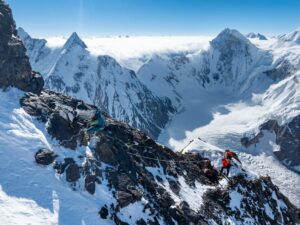
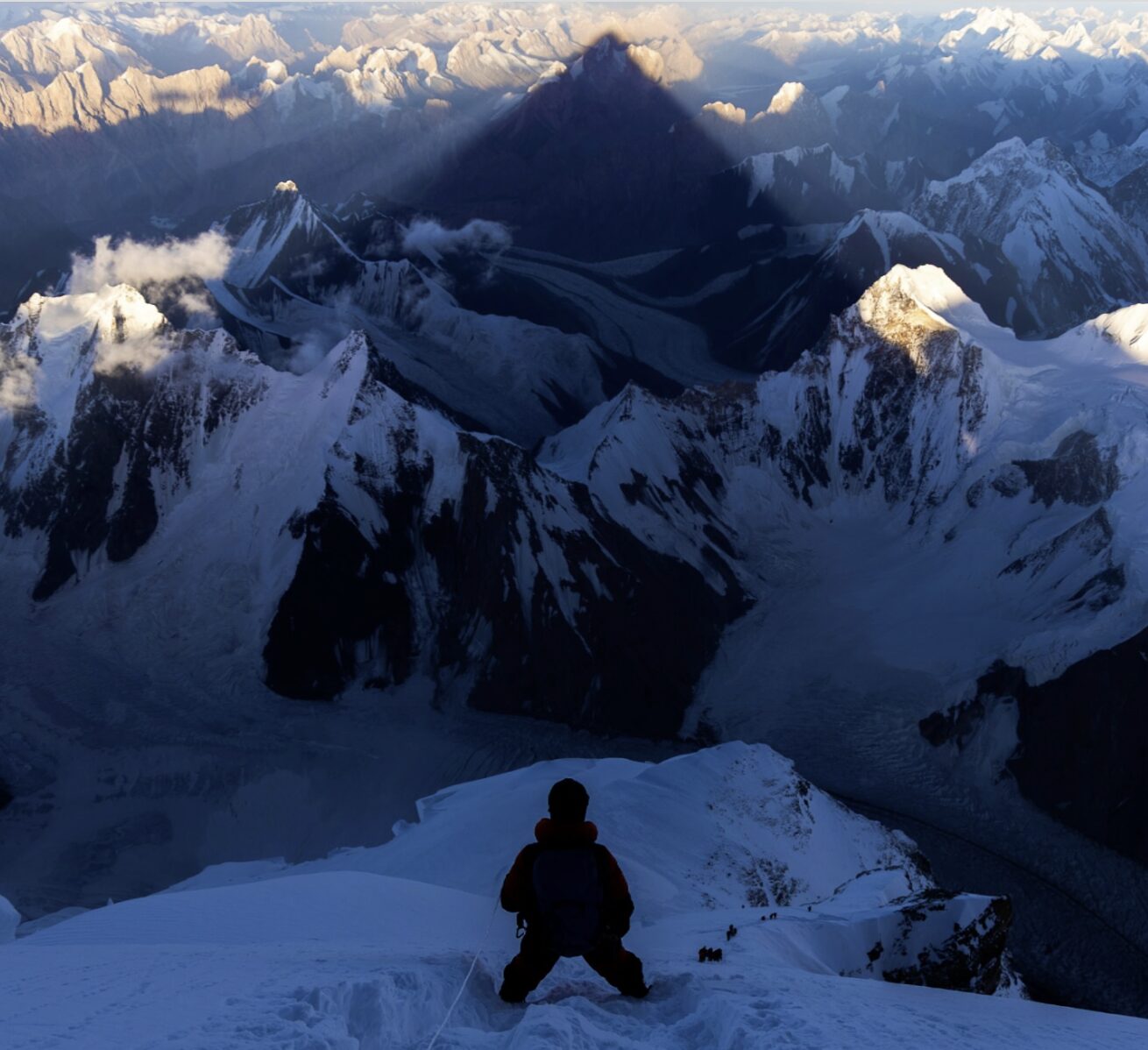
Views from high on K2. Photo: Sohail Sakhi
Fenced Camp 1
Hardy also pointed out an unpleasant method used by commercial teams at Camp 1, located on a scree slope where space for tents is scarce. “I was among the first climbers who reached Base Camp, yet, when I climbed to Camp 1 to pitch my tent, I discovered the best patches had been surrounded with poles and wire ‘reserving’ the space,” he said. “I managed to find a sketchy spot to plant my tent on a tilted slope, and yet, when I returned days later on an acclimatization rotation, I found my own tent surrounded by these wires!”
Hardy shared some pictures and a video (below) filmed by another climber showing tents surrounded by wires and snow poles: