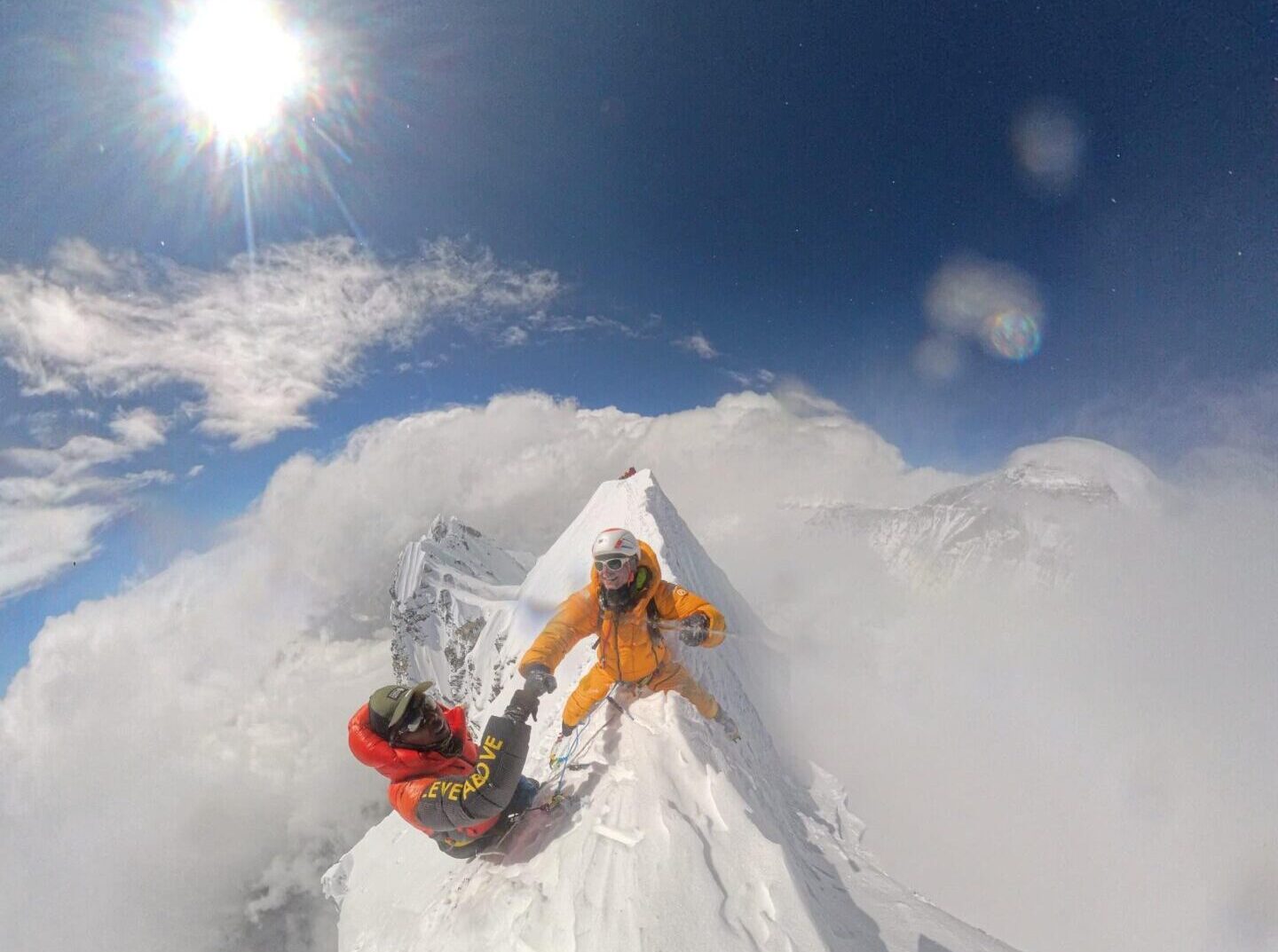
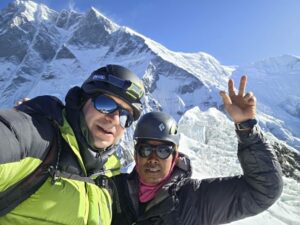
Dawa Tenji Sherpa, left, and Jay Whiting on the summit of Nuptse. Photo: Jay Whiting
Climbing Everest, Lhotse, and Nuptse in a single season is so rare that only four people have done it. Each peak has its own difficulties, but Nuptse is the least familiar and most technical, even for oxygen-assisted climbers on fixed ropes.
Jay Whiting of the UK and Dawa Tenji Sherpa completed this Triple Crown this spring. It made Whiting only the second Briton to complete it in one season, after guide Kenton Cool, and the fourth person overall. At 33, he is also the youngest. But most remarkably, the guy in front of him, Dawa Tenji Sherpa, has now done it twice.
PART I: CONTEXT
Sharp and technical
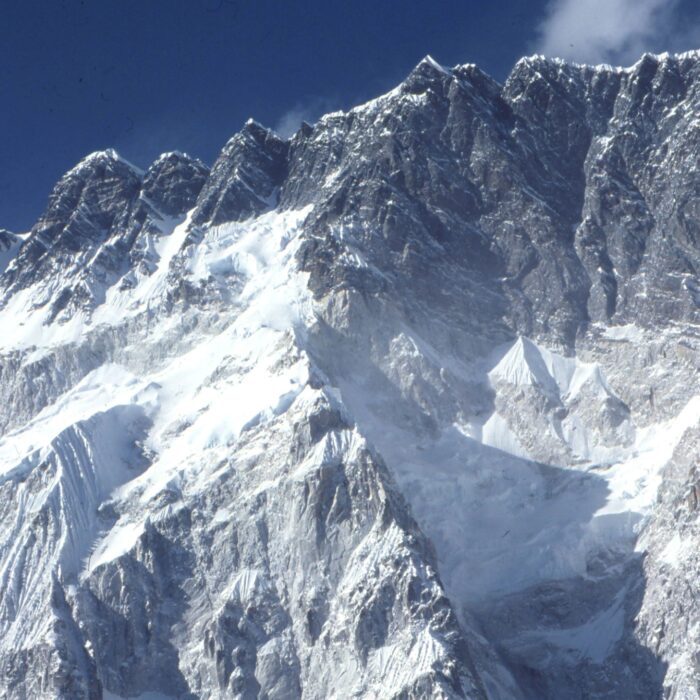
Nuptse is sharp, technical, unforgiving, and dangerous if conditions are not right. At 7,861m, it is an almost-8,000’er. Consider: Until the end of 2024, a total of 12,884 people had summited Everest, including 9,156 from the Nepalese side. Only 38 had summited Nuptse, according to The Himalayan Database.
Since Denis Davis and Tashi Sherpa first stood on Nuptse’s summit in 1961, it has attracted some of the best high-altitude climbers in the world. There have been epic, alpine-style ascents on new routes, from Doug Scott and Al Rouse’s on the North Face in 1979 — only the second ascent — to Ueli Steck’s ill-fated last solo in 2017.
Then, there are the Piolet d’Or-winning lines: the South Face by France’s Helias Millerioux, Frederic Degoulet, and Ben Guigonnet in 2017, or Valery Babanov and Yuri Koshelenko’s climb via the Southwest Buttress to the slightly lower East summit in 2004.
Nuptse. Photo: Valery Babanov
Other meritable climbs ended unsuccessfully. The mountain defeated Tomaz Humar (whose partner, Janez Jeglic, was blown off the mountain to his death), and the strong team of Steve House, Barry Blanchard, Steven Koch, and Marko Prezelj.
Until recently, the peak was climbed without supplemental oxygen. The North Ridge, accessed from the Camp 2 common to Everest and Lhotse, was hardly a typical “normal” route. Success only seemed within reach of such excellent climbers as David Goettler, Gerlinde Kaltenbrunner, the Benegas Brothers, Alex Txikon, Ralf Dujmovits, Kenton Cool, and Pete Athans.
Outfitters ignore Nuptse
Since the beginning of commercial expeditions in the 1990s, outfitters usually ignored Nuptse for practical reasons. It was too hard, and it lacked the commercial appeal of an 8,000m peak.
The idea of a Triple Crown was unknown. Climbing Everest, Lhotse, and Nuptse was a lifetime goal, not a seasonal one. The first to climb all three was Ralf Dujmovits of Germany, who summited Everest in 1992, Nuptse in 1996, and Lhotse in 2009.
In the spring of 2013, guide Kenton Cool climbed all three in the same season for the first time. His Nuptse summit was controversial for a while because Alex Txikon of Spain, who was with him, initially believed that they had not reached the highest point.
While others on the team stopped at a point they thought was the top, Cool and Txikon continued along the knife-edged summit ridge. Txikon thought they went up as far as possible, but that there remained some 150m to go.
However, Txikon changed his mind years later, as he told ExplorersWeb in 2022. After we posted that story, Txikon discussed the matter with Cool and with Billi Bierling of The Himalayan Database, and cleared up the facts. Both Cool and Txikon now appear in The Himalayan Database as Nuptse summiters. Both did their climb without oxygen.
The final ridge
When asked about it, Jay Whiting explained that the true summit of Nuptse can be confusing but can be identified if enough summit pictures are provided. He supports the validity of Alex Txikon and Kenton Cool’s summit.
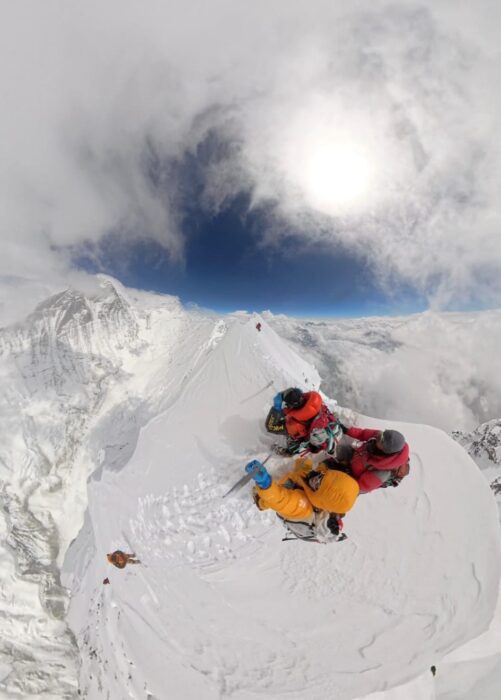
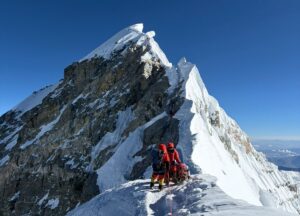
Whiting explained that some people may stop at a small shoulder on the summit ridge, photo below, but the true summit is well beyond.
Climbers on the summit ridge of Nuptse. Photo: Jay Whiting
“The final traverse is on a knife-edged, corniced ridge,” he explained. Whiting was able to record part of the (terrifying!) traverse while holding the ropes and using his cell phone on a selfie stick at the same time:
Angela Benavides graduated university in journalism and specializes in high-altitude mountaineering and expedition news. She has been writing about climbing and mountaineering, adventure and outdoor sports for 20+ years.
Prior to that, Angela Benavides spent time at/worked at a number of local and international media. She is also experienced in outdoor-sport consultancy for sponsoring corporations, press manager and communication executive, and a published author.