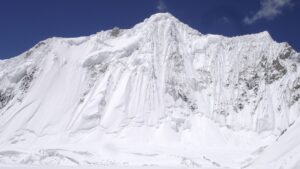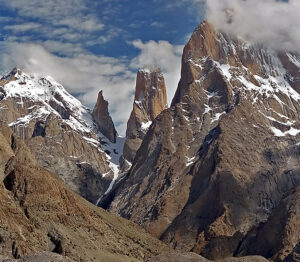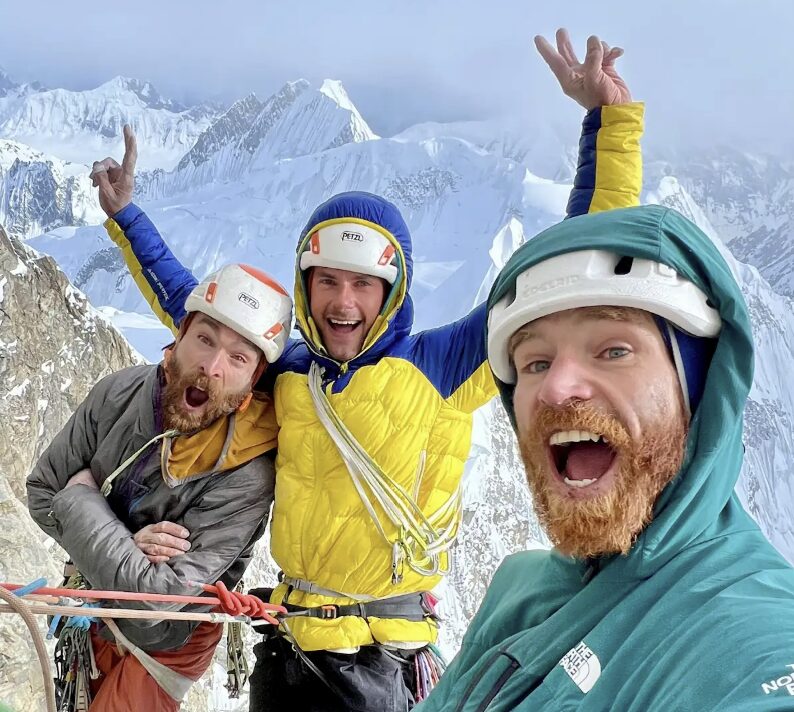
Sean Villanueva O’Driscoll, Siebe Vanhee, and Symon Welfringer were planning something big in Pakistan, but they did not reveal what it was until it was done and they were back home. The elite trio has made the first ascent of the west face of 6,651m Tahu Rutum, a Patagonia-like spire in the remote Hispar region.
The Leopard of Higher Ground, as they call their new line, climbs 1,500m up the virgin west face of the mountain. It links the lower rock wall with the main summit spire via a series of steep snow traverses.
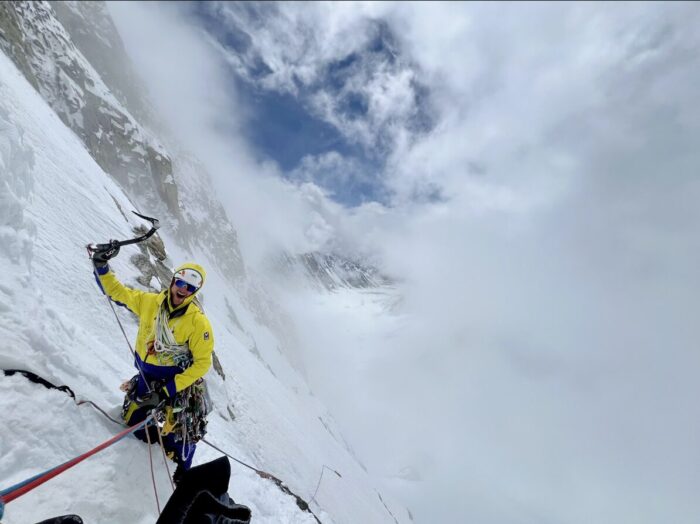
Welfringer on a traverse. Photo: Vanhee/O’Driscoll
The team spent 13 days on the wall to reach the summit with what they describe as a “demanding mix of capsule-style big-wall climbing and alpine techniques.” They used static ropes and hauled their portaledges, but then free-climbed every pitch. That was the final goal. Then, they needed two more days to descend.
This was the first-ever complete ascent of the west face and the second overall ascent of Tahu Rutum, after a 1977 Japanese team summited via the southwest ridge.
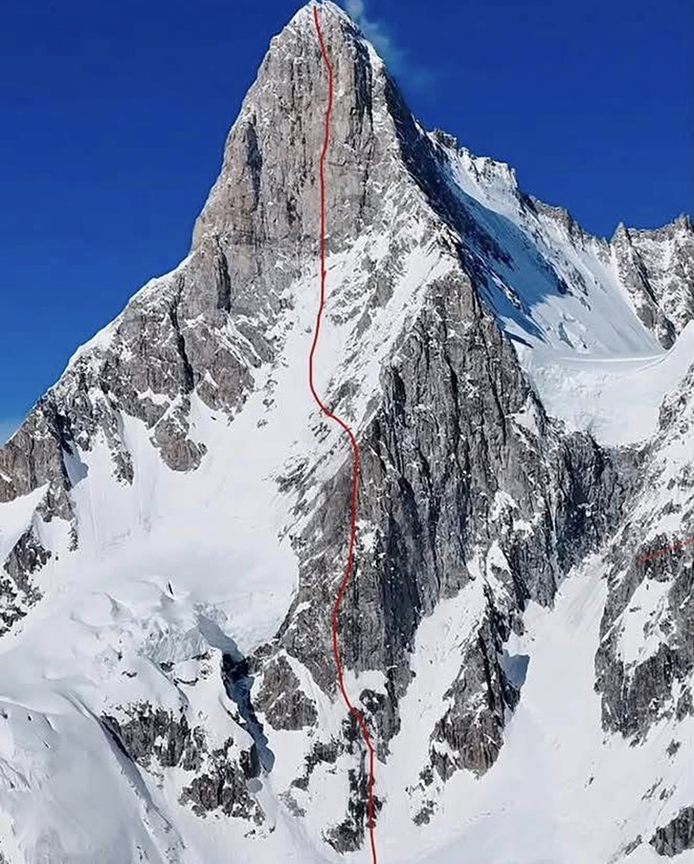
The new route on Tahu Rutum. Photo: Vanhee/O’Driscoll/Welfringer
An old dream
Despite its remoteness, the striking profile of the west face of Tahu Rutum — also spelled Taa Hurutum in the local language — had been in the minds of several first-class alpinists. However, the most serious attempt was made by American daredevil Kyle Dempster, who tried to solo the face in 2008. He spent 23(!) days on the wall and retreated just 200m below the summit.
Six years later (and two years before Dempster died while climbing in Pakistan), Siebe Vanhee met with him and heard the story of the attempt firsthand. Vanhee has dreamed of that face ever since.
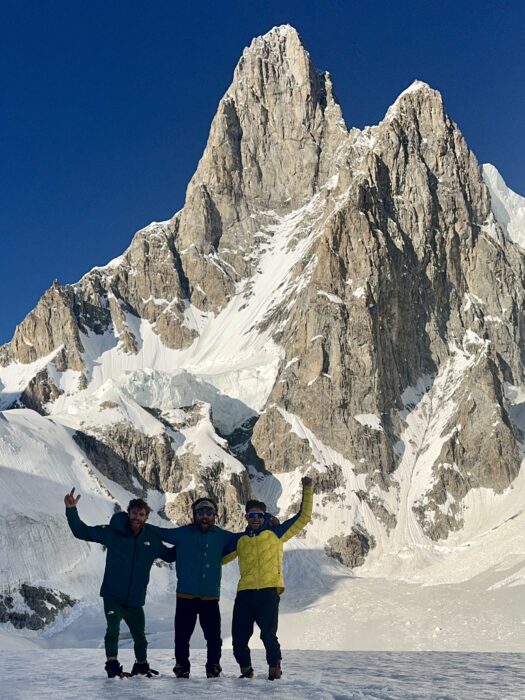
The team in Base Camp. Photo: Courtesy of the team
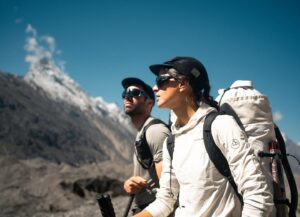
Finally, in May of this year, Vanhee joined fellow Belgian Sean Villanueva O’Driscoll, Symon Welfringer of France, and Pete Whittaker of the UK. Whittaker, unfortunately, had to bail shortly after reaching Base Camp due to Acute Mountain Sickness.
The most ridiculous line
Vanhee describes their route as “the most ridiculous line, which not a single alpinist would choose.” Instead of taking the obvious glacier approach to the face, they tackled the crumbly lower sections on rock, aiming to reach the face by linking snow ramps. The result was eight pitches on bad rock, followed by 10 days of hauling their gear and food for 15 days across steep snow traverses and difficult terrain before even reaching the headwall.
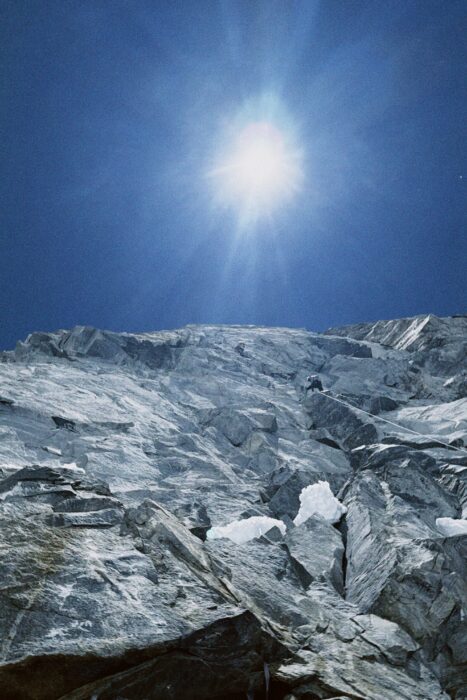
Looking up the route. Photo: Courtesy of the climbing team
At a certain point, a bag they were hauling got stuck between rocks, and Vanhee had to lower himself down to free it. Villanueva O’Driscoll described the moment as follows:
Suddenly, the haul line cut on a sharp edge. We all looked at each other in disbelief — somehow Siebe managed to catch it before it fell. If it had fallen, it would have been the end of the ascent, as there was a lot of important equipment in that pig.”
[Note: Big wall climbers often refer to the heavy duffel bags they haul up a wall as pigs.]
The bright side of hauling
Vanhee admitted he cursed all the way. “But this is what we do,” he added. “It’s a big-wall climber’s line at high altitude, and it was worth it.”
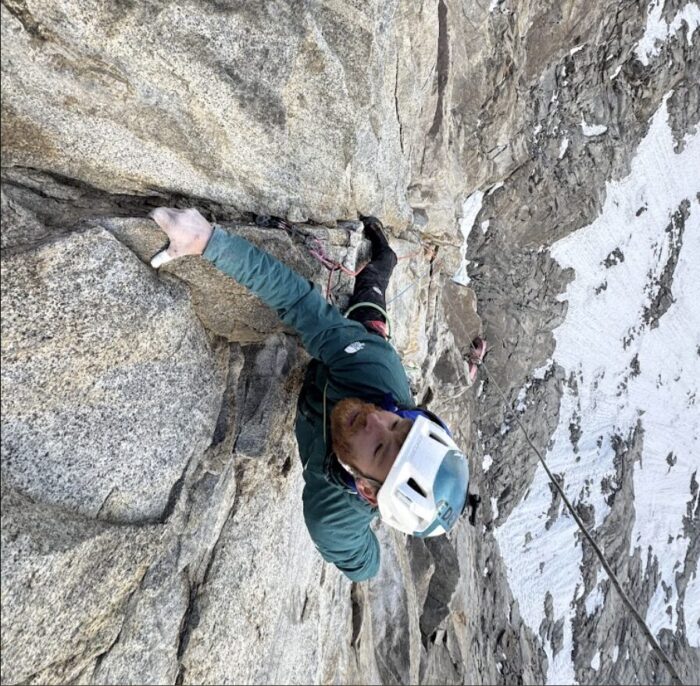
Siebe Vanhee on the route. Photo: Courtesy of the climbing team
It was worth it because that way, the team free climbed every pitch, and because, loyal to O’Driscoll and Vanhee’s Patagonian climbing habits, they stayed in their portaledges when stormy weather came along.
For Welfringer, however, it was a new experience. A seasoned alpinist with a Piolet d’Or for the first ascent of Pakistan’s Sani Pakkush with Pierrick Fine in 2020, and several expeditions to remote areas in Pakistan, it was the first time he applied big-wall techniques to high-altitude climbing.
“The experience opened my eyes to a new style of climbing at altitude, and I think the possibilities are endless,” he said. “I am already dreaming of [free climbing] other new lines.”
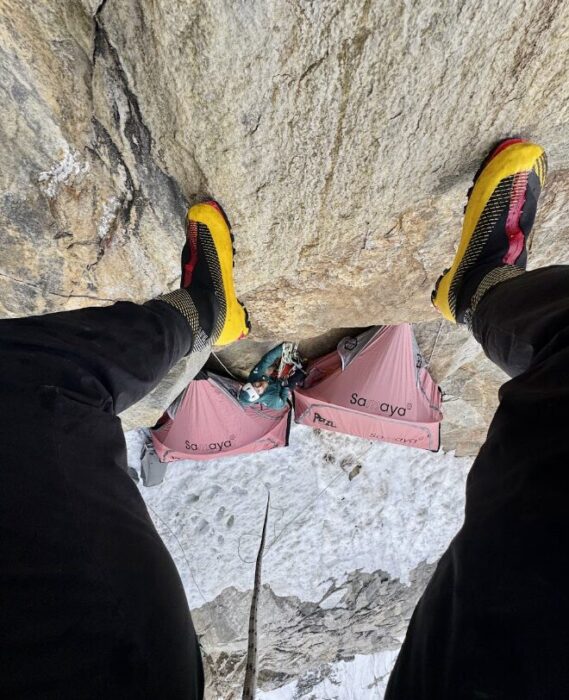
Portaledges as seen from the headwall. Photo: Siebe Vanhee
The headwall
Finally, on the 11th day of the climb, the team reached the headwall at 6,260m. Awaiting them the following morning was the crux of the climb: steep, overhanging terrain above 6,000m, with free climbing up to 7b. There, they fixed the 400m of rope they had with them.
By the 13th day, they were exhausted, but the weather was too good to waste by resting. The team climbed up to the top of the ropes and continued up to the summit.
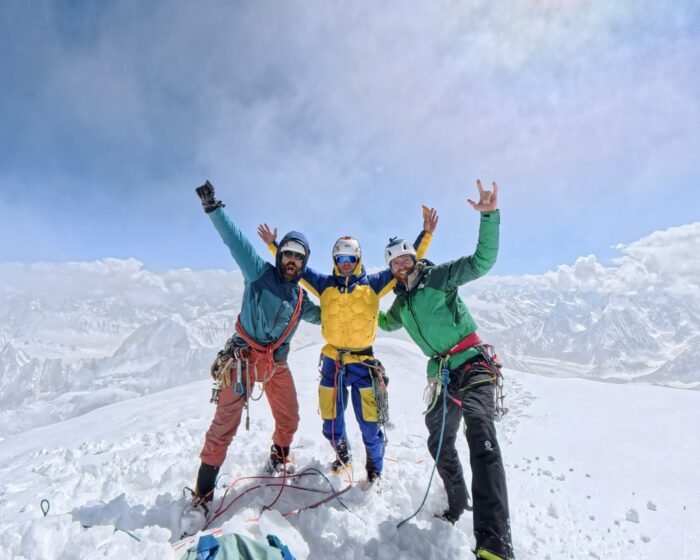
Happiness on the summit. Photo: Courtesy of the climbing team
A tribute to Kyle Dempster
On the face, the team crossed Kyle Dempster’s attempted line and found three of his old anchors. They named the route as a tribute to his climbing genius. Tahu Rutum means “the home of the snow leopard,” and Dempster owned a coffee shop in Salt Lake City called Higher Ground, so they linked the two names to form “The Leopard of Higher Ground.”
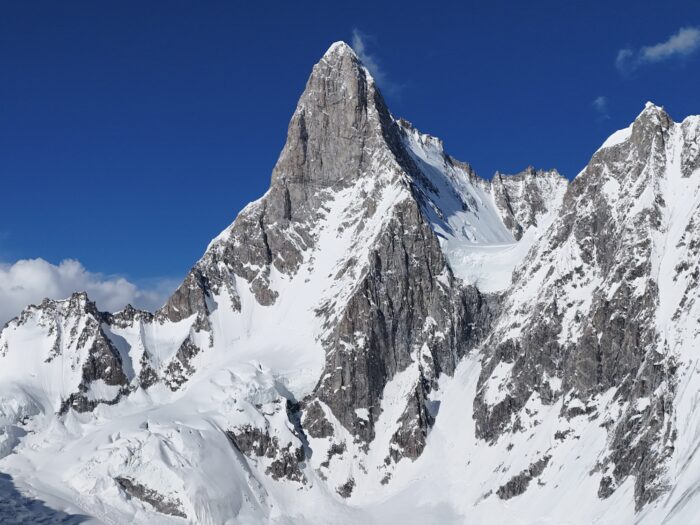
The west face of Tahu Rutum, as seen from a drone. Photo: Courtesy of the climbing team